

Deconstructing Left Me Hungry
Your intellect won’t save you, but a meal might.

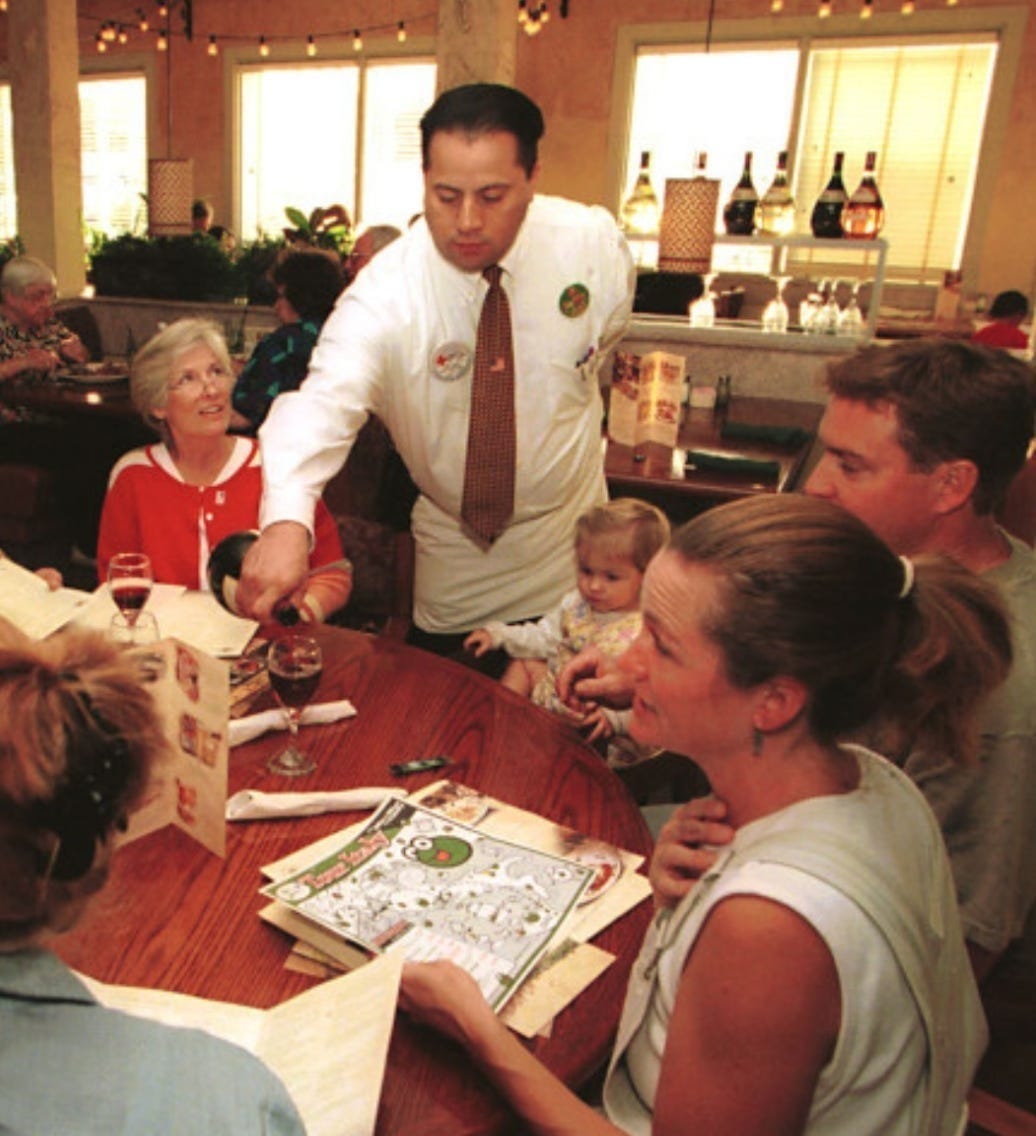
When I think back to childhood memories of church, hazy and fond images come to mind. I remember skits and sermons, snack times and craft times, Bible stories and oh-so-many songs with hand motions. I remember my family loading into our minivan on Sunday mornings to drive there, and my mom asking “What did you learn today?” on the ride back. (I laugh remembering how often I’d say, “Nothing new!”, insistent that I was already familiar with the lesson the Sunday school instructor tried to teach me.)
Some of my favorite memories are going to lunch after church — especially when that lunch was Olive Garden.
It was fine dining in my eyes: the best Italian-American casual dining experience that Branson, Missouri had to offer. The breadsticks were endless, freshly-grated parmesan could be summoned at a word, and the check always came with complimentary Andes Mints. The cumulative effect was a full stomach and lingering nostalgia for a chain restaurant. I truly believe post-church lunch is as critical to a Sabbath practice as anything else; every friend of mine who grew up in a churchgoing household can name a regular spot their family went to lunch, and it’s usually attached to distinct moments from childhood.
What I remember less distinctly, however, is the part of church that actually involved food — the Lord’s Supper. I have to strain my mind back to gather any real memories of Communion in my church growing up; breadsticks evidently left a greater impression on me than the Bread of Life did. I’m pretty sure it involved prepackaged wafers and juice distributed throughout the church auditorium, but even that image may be colored by later experiences.
From the fragments I have, I vaguely recall it seeming an odd ritual. “Do this in remembrance of me”, they said, quoting Christ. Sure, the unfermented grape juice sort of looked like blood, but it was hard to see why bread (let alone a nickel-sized wafer reminiscent of cardboard) much resembled a body. Not the most intuitive way to remember a crucifixion.
Faith, as I had internalized it, was primarily about ideas and emotions — believing the right things and feeling the right things about those beliefs. Once-a-month bread and juice didn’t have much to do with either, but I didn’t question the practice, and could hardly imagine it as anything other than how it had been presented to me: an edible symbol, a memorial and metaphor, meant to remind me of those truths I’d been taught to believe. Neither did I have any reason to question the faith I’d been raised with.
Eventually, though, I would grow up. And as I got older, questions of other sorts began to put fissures in that faith.
Ye Shall Know the Truth
Sometimes I’ve wondered if I should describe my spiritual journey as a “deconstruction” — a term that gets thrown around plenty in online spaces. On one hand, most stories I hear about deconstruction involve a degree of crisis, and that’s never quite been the case for me. I’m grateful to have had parents and teachers who welcomed questions rather than shutting them down. For me, it has felt less like deconstruction and more like the growth that should naturally happen in the life of faith.
On the other hand, my journey has involved reassessing inherited assumptions. Often, theological curiosity has led me to different places than where I started. Sometimes it’s resulted in convictions at odds with those of people I respect. But I had been raised to be well acquainted with the words, “The truth will set you free”; if Jesus really meant that, and I think he did, then truth is well worth pursuing.
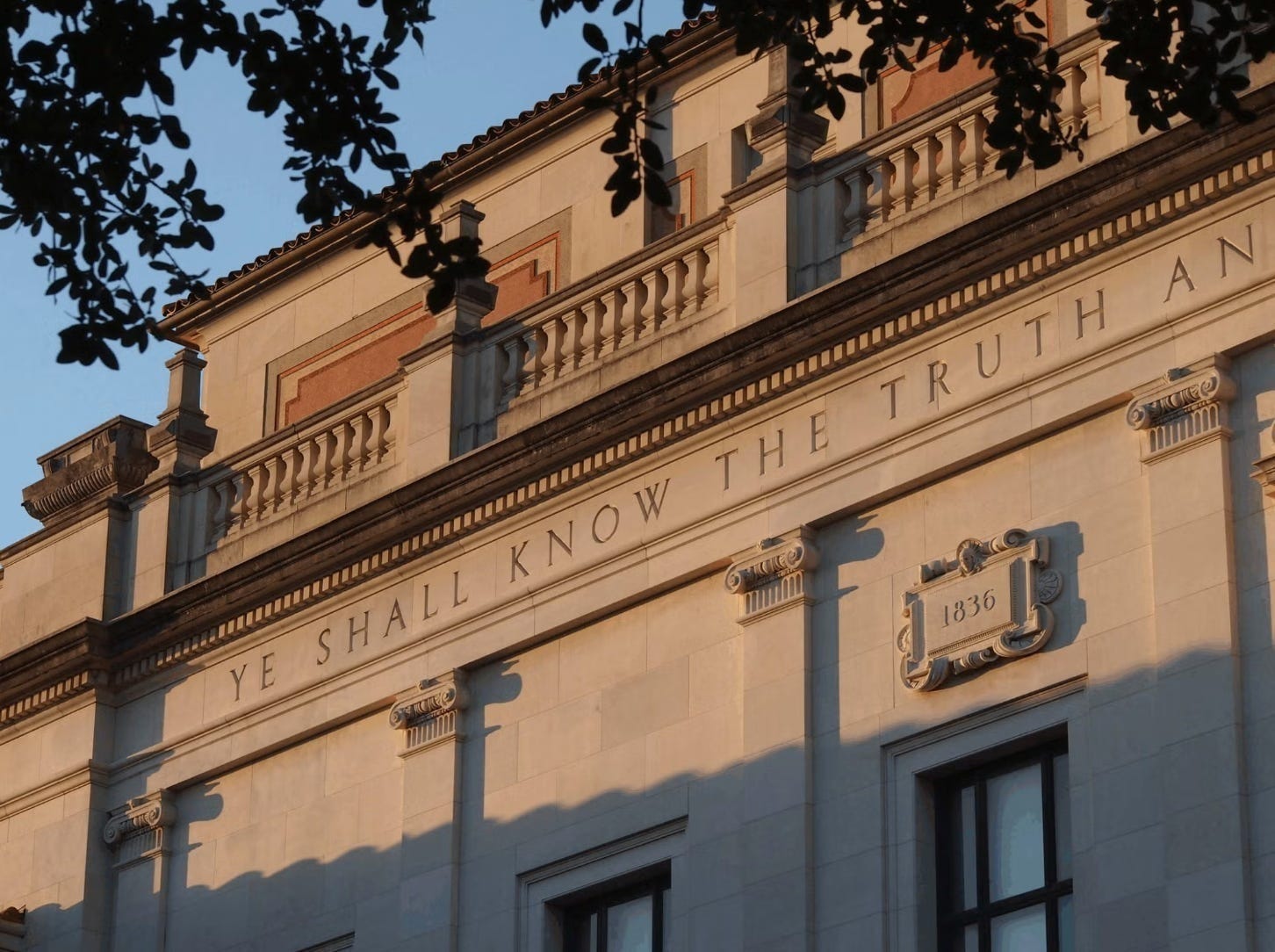
King James’ rendering of that saying is inscribed on the main tower of UT Austin, and it was during my early years there that I was in the deepest throes of spiritual exploration. I think I visited a different kind of church every Sunday my first semester. When I wasn’t denomination-hopping, I was doing doctrinal grocery shopping. I detached myself from Biblical inerrancy, read into historical critical theory, and investigated whether Scripture was as authoritative or inspired as I had been led to believe. I evaluated views I’d once taken for granted, from gender hierarchies in Genesis to the rapture and Revelation. I found my way to process theology podcasts and exhausted myself on exvangelical Twitter threads. For better or worse, I felt the freedom to explore everything that was out there.
Any opinion was on the table, except perhaps those who would adamantly insist on reading the whole Bible literally.
For as much as I saw myself as an earnest truth-seeker, I look back and see mixed motivations. Pride was certainly a factor. I fancied myself a curator re-cataloguing my internal inventories — sifting through years of evangelical upbringing — to replace those ideas with better ideas, which would then produce better emotions.
You might see where this is going. A faith centered around acquiring knowledge will have you bound for boredom or burnout, and I hit one then the other. By the end, I wound up with a wider vocabulary for theology, but not any holier or happier because of it. The nuances I discerned didn’t make me any more of a saint. Honestly, it probably made me more annoying.
My spiritual practices stagnated over that period. Scripture felt more confusing than ever. I kept attending a church, but at heart, I was still my younger self sighing, “Nothing new,” after sermons that failed to deliver certainty.
Ideas and emotions weren’t enough. I needed something more real than concepts to keep in my head, something more substantial than feelings. Not something I could construct or deconstruct, but something to receive.
I didn’t know it yet, but I needed something to eat.
The Priestcraft of Cooking
Most of my best memories involve food. I could associate every era of my life with certain meals.
Childhood was marked by the aforementioned Olive Garden, of course, but the zuppa toscana my Mom made was just as good as the restaurant stuff. Neither could I neglect to mention my Dad’s breakfast fixes — his chocolate chip pancakes in particular. Summers spent at camp were inseparable from coffee cake, as well as blueberry muffin pitstops on the drive to and fro. Moving to Houston at age 11 meant the exhilarating introduction of new flavors: Korean barbecue before a pool party, banh mis after church, Tex-Mex spreads on Christmas Eve. High school came with tacos el pastor from the truck down the road, Bible studies over jambalaya, and hot wassail in the winter. College began with solo trips to grab pizza from the cafeteria, but grew to include sumptuous friendship shared over penne alla vodka. Undergraduate also ushered in my first forays into cooking for myself; I could recount an evening spent making chicken tikka masala with much rejoicing, and one attempt at a vegan lentil pasta with remorse. Plenty of parties and concerts ended with me and my friends seeking refuge at Waffle House. Even when I couldn’t recall any other precise details from an event, memory of the meal persists. Friendsgivings, first dates, formals, and birthday dinners — so much about relationships is tethered to recipes or restaurants.
Why is it possible to tell a life story by way of the things you eat? It’s because food is inherently communal. People gather when a meal is served.
For much the same reason, food is an art. This is not the case by necessity, but because we choose to make it so. If you really wanted to, you could save a lot of time and money consuming only the bare minimum required for sustenance. But who would want to live like that? We go out of our way to embrace the extravagance of an elaborately crafted meal — made under the care of someone who knows how to cook skillfully, and in the company of friends and family — because we want something that brings delight to our senses and brings us closer to those we love.
A meal is never less than sustenance, but a good meal is so much more than that. A perfect risotto, a thoughtful pairing of charcuterie and wine, an immaculately smoked brisket: these have an almost supernatural ability to bring people together. I’m only slightly exaggerating here; I’m convinced any truly magnificent meal has a spiritual dimension to it.
Cooks are the chief officiants in this ceremony. They bring hints of the transcendent into the realm of the tangible, and elevate our animal appetites to higher things. Eating is a necessity due to our creaturely need for nutriment, yet in practice, it becomes a reminder of the richness of our own desires. The food doesn’t even need to be special. A greasy burger and fries when you’re still out at 2AM will have you seeing the Kingdom of Heaven.
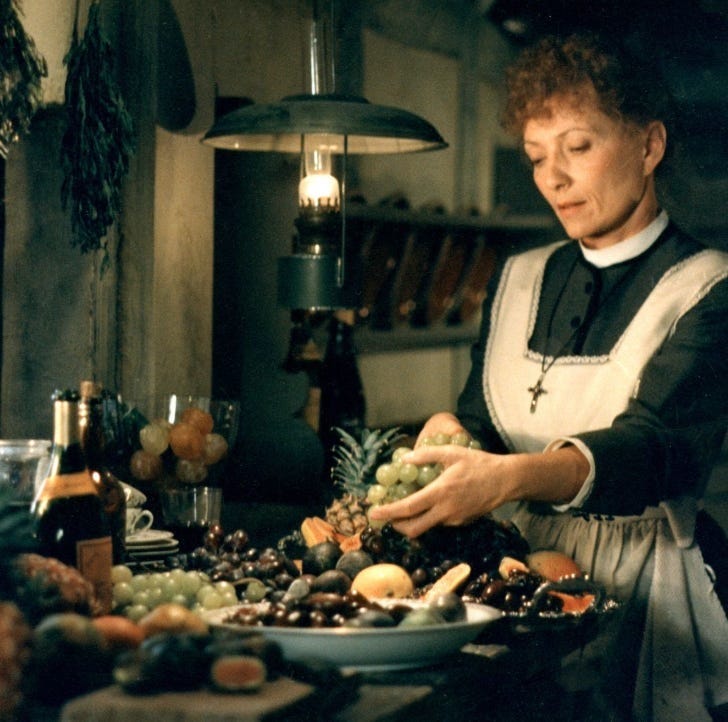
A similar “theology of food” is at the heart of the 1987 film Babette’s Feast. The story centers around an elderly, pietist congregation in a Danish fishing village, whose members have grown cold and callous toward one another after the death of their pastor. To their surprise, and almost against their will, the churchgoers are treated to a luxurious meal prepared by Babette, a French maid with a generous heart.
The climax of the film is the dinner itself. Over the course of the meal, a change starts to set over the dining room. As wine is poured and food is shared, the dour and suspicious assembly starts to let their guard down, and they begin reminiscing with one another. As the evening grows late, you see old bitternesses begin to dissolve. Forgiveness is asked and given. Laughter breaks out. And by the end of the feast, there is life in their eyes again — joy that sees sensuous and spiritual appetites as indistinguishable, because both hungers have been met.
It is a profoundly joyful film, and a profoundly Christian one.
Babette is a priest. Her feast invites both communion and thanksgiving — what Christians from the early ages understood to be central to their worship. This is a picture of the Eucharist.
A Memory of Kingdom Come
An earlier attempt at forming these thoughts had an extended digression into Eucharistic theology, which I thought better of. Instead, I would just offer these words from Jesus in John 6: “Those who eat my flesh and drink my blood have eternal life, and I will raise them up on the last day, for my flesh is true food, and my blood is true drink. Those who eat my flesh and drink my blood abide in me and I in them.”
It’s uncomfortable, isn’t it? Here, our Lord cryptically states that resurrection — that grand, final, embodied hope of the Christian faith — requires eating and drinking of himself. It makes most contemporary articulations of faith seem quaint. What Jesus describes is fleshy, visceral, even violent. Yet that is what union with him supposedly entails.
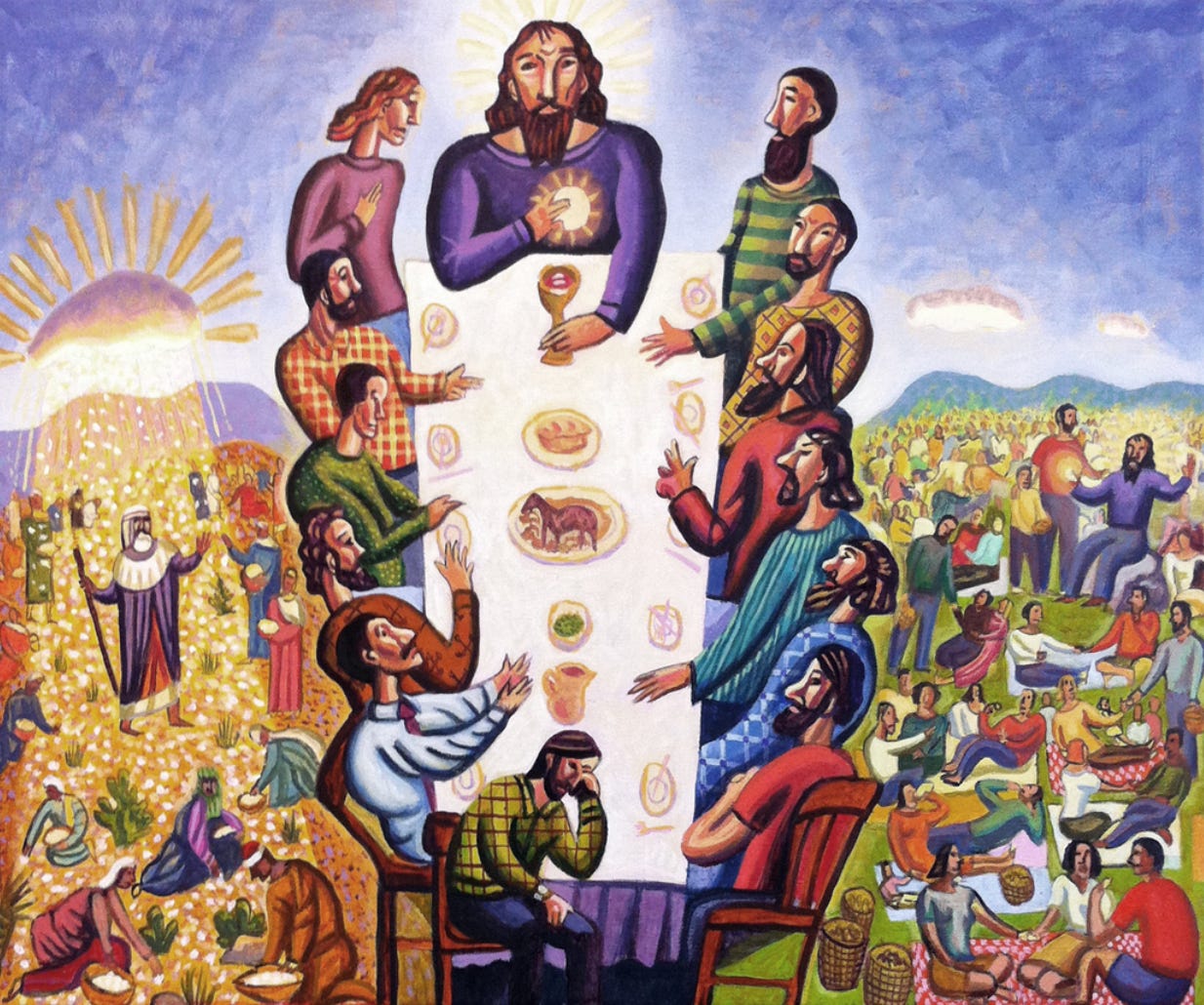
Coming from a non-sacramental tradition, the notion that bread and wine could be called the real body and blood of Christ felt both bizarre and medieval. Yet both because of my spiritual exploration and in spite of it, my own sense of certainty was cracked wide enough to entertain the possibility that maybe, just maybe, I should take Jesus at his word.
It meant, ironically, reading the Bible literally.
Thinking back on my “deconstructive” period, it strikes me how removed my spiritual angst was from any of the relationships in my life. I was searching for certainty all on my own, without talking to friends or mentors, and without even talking to the God whom I allegedly sought to understand. It was a solitary endeavor and, if I’m being honest, enabled and exacerbated by the internet. I might have wound up abandoning my faith altogether had I not been eventually drawn in by something else, something other. It was neither ideas nor emotion that I needed, but encounter.
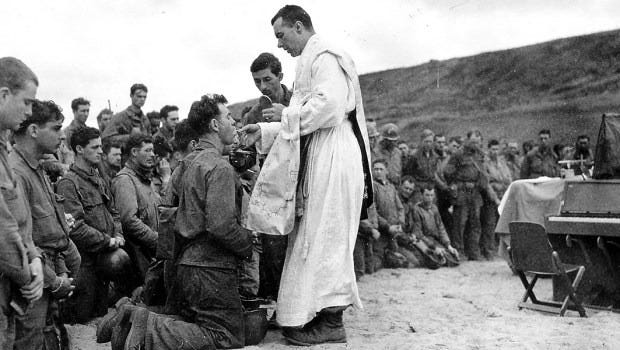
The Lord of the Feast drew me to his table beneath the surface of my own consciousness. By grace, I stepped into a parish where Communion was celebrated week in and week out. Prior to all my past church experiences, the central aspect of worship wasn’t words spoken from a pulpit, nor songs intended to stir up ardent feelings — but common and mundane elements, lifted up and blessed: no less than bread and wine, but so much more. The enchantment and merriment of the sacrament seeped into my bones gradually, and then all of a sudden.
This was Christ’s real presence offered in a meal.
My understanding of the Eucharist didn’t change by gaining more knowledge about it, although that would come in time. Rather, my understanding of the Eucharist changed by entering into the divine liturgy and receiving. I found myself wracked by realization and wonder those first few months. What once seemed unimportant to me became crucial; what once felt confusing was now utterly and delightfully mysterious. To receive Communion is not just to reflect on the past — it is an encounter that overflows into revelry and friendship in the present. More paradoxically still, it’s a foretaste of things yet to come.
There is one memory, especially dear to me, of a dinner I shared with friends shortly before our graduation. We sat around a long oak table one evening in the Texas Hill Country, stars above our heads, with a glorious array of ribs, brisket, and sausage laid out before us. Like the meal in Babette’s Feast, our conversation was joyous and laughter-filled, and increasingly so as the night went on. In the middle of all this, I felt a strange emotion come over me — you could perhaps call it gratitude. With it came the thought that, Whatever I’m feeling right now in this moment is something I wish I could feel forever.
It is among a few moments in my life that have felt like a flash of Heaven in the present. You might have a similar memory in your life.
The knitting-together of community, the gift of sustenance, and a startling awareness of the immanence of God were all present to me in that moment. This is what Christ offers us through union with himself. It is the truest desire of our hearts — relationship so deep, so intimate, so real and present that you’re not just sitting at his table, but that he is the very thing you’re being nourished by.
The Eucharist is a tangible offering of that hope, something I can count on even more than I can count on my own mind to make sense of it.
There’s real magic in the world, and it’s as tactile as breadcrumbs between your teeth. The mystery that binds the cosmos together can be imbibed in a sip of port wine. Love — death-killing, sin-shattering, hell-harrowing Love — has given its incarnate self to you in a meal. You need not be able to explain why or how this is so. Take, eat.
–HTR
Faith makes the most sense not when you’re ignorant of how it works, but when you let go of pride long enough to give yourself permission to drink deeply, to trust, and to obey… and to receive the belonging that draws you back to the table. I loved the article, and for some reason I’m hungry now. 🤔
Wonderful piece. And zuppa tuscana mentioned 🚨🚨🚨